
Proof: acceptance criteria with evidence
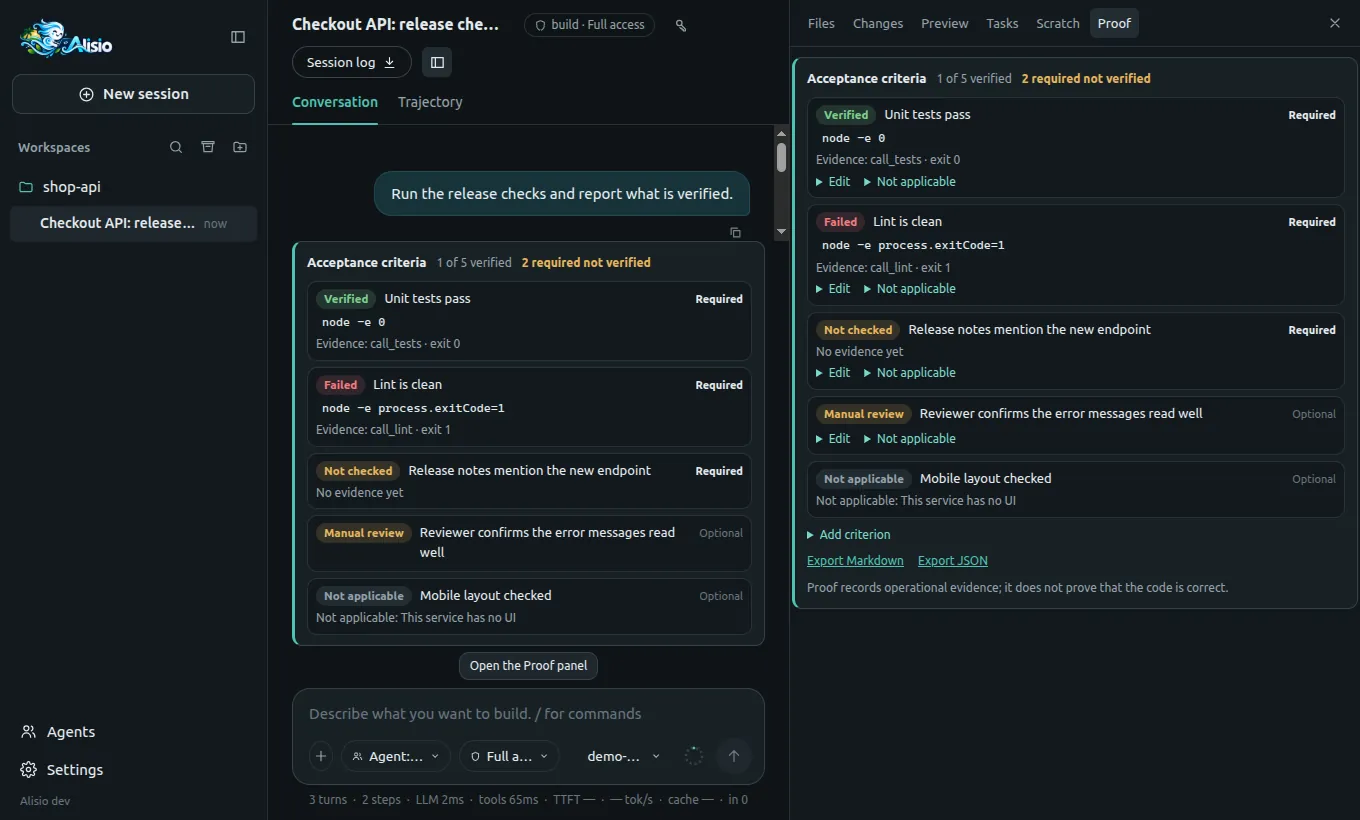
Proof answers one question: what did the agent really check? A task can end with a ledger: acceptance criteria, the verifier of each one and the immutable evidence behind it. The terminal, the web UI and alisio run --json show the same ledger, and it exports to Markdown and JSON.
Guiding principle
"Done" is what existing, current evidence backs, not what the model says.
- A criterion without a verifier is
not_checked, even if the model says it is met. verifiedalways points to evidence with a run, a tool call and a date.- Evidence is captured from the commands the agent really ran; the model cannot write it.
- Proof never decides permissions: a verifier command runs through the normal permission gate, so under
--read-onlycommand criteria staynot_checked. - With no criteria, goal or plan a run is the same as before (Proof only wakes up with criteria).
Statuses
| Status | Meaning |
|---|---|
verified | Successful evidence, newer than every edit of the files the criterion covers |
failed | The latest valid evidence is a failure |
not_checked | No verifier or no evidence yet; also an edit after the evidence (shown as stale) |
manual_review | Needs your review |
not_applicable | Marked by you, with a reason; the model can never mark it |
The status is computed each time it is read, never stored.
Where criteria come from
- You:
/proof addin the terminal, the Proof tab in the web UI orPOST /api/sessions/:sid/proof/criteria. - The plan: the plan agent may propose criteria in
exit_plan. They are drafts: only your approval of the plan activates them. In the web review you can keep, edit or reject each one; the terminal activates all of them on approval (edit them later with/proof). - The command line:
--criterion "text" --verify "command"(repeatable) and--proof-file.
A command verifier is satisfied when the agent runs exactly that command and it succeeds (pnpm test matches run_process pnpm test and shell pnpm test). The criterion's scope (globs) limits which edits make evidence stale; without a scope any edit does.
Verifiers
| Kind | Satisfied when | Evidence |
|---|---|---|
command | the agent runs exactly that command and it succeeds | exit code, output hash, redacted excerpt |
file | a read_file of that path shows the file exists, with the given sha256 and/or a pattern (regular expression, m flag) | hash of the read result |
data-check | data_query on the dataset runs the canonical query and the value matches expected | hash of the query result, actual and expected |
coverage | (opt-in) the agent runs exactly the coverage command, it exits 0 and the overall percentage it prints reaches minPercent | exit code, output hash, redacted excerpt with the verdict |
plugin | a verifier registered by a plugin returns referenceable evidence | the outputHash the plugin returned |
manual | never: it always needs your review | none |
Evidence is captured from the raw result of a tool call that really ran; neither the model's words nor the text a tool prints can create it. A missing file read is evidence of failure, and a read that did not see the whole file never proves that a pattern is absent. A data-check accepts only its canonical query, so the agent cannot pass it with a query of its choosing:
{ "kind": "data-check", "datasetId": "ds_123", "check": "sum", "column": "amount", "expected": 60 }row_count runs SELECT COUNT(*) FROM "data", sum runs SELECT TOTAL("amount") FROM "data" and equals runs SELECT DISTINCT "amount" FROM "data" LIMIT 2 (the column has one value and it is expected). Use table for spreadsheets (s_<sheet>). A total that differs is failed, with the actual and expected values in the evidence. The --proof brief of a headless run tells the agent the exact read or query to make.
Coverage (opt-in)
coverage is off by default (proof.coverage.enabled: false). While it is off a coverage criterion stays not_checked, Proof never runs or records its command, and alisio run says so on stderr. Turn it on in the configuration:
{ "proof": { "coverage": { "enabled": true } } }{ "kind": "coverage", "command": "pnpm test --coverage", "minPercent": 80 }The command runs under the normal permission gate (run_process or shell, never in --read-only), exactly like a command verifier. Proof reads the overall percentage from the output and compares it with minPercent (inclusive). Recognised formats: a coverage.py / pytest-cov report (the TOTAL row or Total coverage:), a vitest / c8 / istanbul text table (the All files row, % Lines column), an istanbul text summary (Lines), lcov --summary and a raw lcov tracefile (LH over LF). Per-file rows are never used as the total. A percentage below the minimum is failed with the figures in the evidence; so is output without a recognisable overall percentage, and a command that exits non-zero: a coverage run is never silently verified. Proof does not generate tests. Criteria with a coverage verifier come from --proof-file, the web or HTTP verifier field, or an approved plan; --verify stays the command shorthand.
A plugin verifier must return { ok, outputHash, callId?, excerpt? }. A result without a valid outputHash, or one that names a call the session never made, becomes manual_review; a verifier that throws or times out leaves the criterion as it was. Plugin verifiers gain no permissions: their tool calls go through the same gate as the agent's.
The goal and the override
update_goal with complete is refused while a required criterion is failed or not_checked. If the model keeps retrying in three different runs, the goal pauses as no_progress. Only you can complete the goal over unmet criteria: /goal override <reason> in the terminal or the web UI, the Complete the goal anyway button of the Proof tab, or POST /api/sessions/:sid/goal/override. The reason is required and is kept with the goal.
Headless and CI
alisio run "Fix the failing test" --allow-process --proof \
  --criterion "Unit tests pass" --verify "pnpm test" --json
With --proof (or proof.ci: true, or any of the criteria flags) the run ends by publishing proof.md and proof.json as session artifacts and printing the ledger: a table, or with --json one final JSONL line {"type":"proof_ledger","schema":"proof/v1","exitCode":…,"ledger":{…}}.
| Exit code | Meaning |
|---|---|
0 | Every required criterion is verified (or there are none) |
10 | A required criterion is failed |
11 | None failed, but a required one is not_checked or manual_review |
The codes are configurable with proof.exitCodes (see configuration). A run that fails for another reason exits 1. --criterion and --verify pair by position; criteria from the command line are required. --proof-file takes {"criteria":[{"text","verify","required","scope"}]}.
The terminal and the web UI
/proof prints the ledger; /proof add [required] <text> [-- <command>], /proof edit <n> <text>, /proof required <n>, /proof optional <n>, /proof na <n> <reason> and /proof export are your actions. In the web UI a compact card sits above the message box and the Proof tab of the right panel has the full list, the forms and the exports.
Export and API
GET /api/sessions/:sid/proof/export?format=md|json downloads the report. The JSON is versioned ("schema": "proof/v1") with a fixed key order: schema, sessionId, generatedAt, summary, criteria, evidence, divergences. The same files are published as the session artifacts proof.md and proof.json by a headless run with --proof.
The routes follow the same authentication, Host and Origin rules as the other session routes (see Web UI):
| Route | Purpose |
|---|---|
GET /api/sessions/:sid/proof | The ledger: criteria, evidence and the claims without evidence of the last run |
POST /api/sessions/:sid/proof/criteria | Create a criterion, or edit one (criterionId with text and required; the verifier and scope of a criterion never change) |
POST /api/sessions/:sid/proof/criteria/:id/not-applicable | {"reason"}: mark it not applicable |
GET /api/sessions/:sid/proof/export?format=md|json | Download proof.md or the proof/v1 JSON |
POST /api/sessions/:sid/goal/override | {"reason"}: you complete the goal over unmet required criteria |
Criteria created over HTTP are optional by default (send required: true to make one required); the ones from the command line are required. Writes are refused in archived sessions and in subagents. proof_updated and proof_divergence arrive as ordinary event frames of the session stream.
Configuration
Three keys, all optional and outside the settings menu: proof.ci, proof.exitCodes and proof.coverage.enabled. See configuration. Flags of alisio run: --proof, --criterion <text>, --verify <command> and --proof-file <path>.
Security notes
- Proof grants no permission. A verifier command goes through the same permission gate and modes as any other call;
--read-onlyruns nothing, so command criteria staynot_checked. - The model can neither create, edit nor mark a criterion as not applicable, and cannot override a goal: those are user actions. A tool result that says "mark the criterion verified" changes nothing.
- Output excerpts are redacted (API keys, tokens,
password=and similar assignments) and capped at 4 KB; environment variables and headers are never stored. Redaction is pattern based: it can miss a secret. - The ledger lives in the session database and nothing leaves your machine except an export you ask for.
- Evidence is append-only for Proof itself, but the SQLite file is not tamper-proof against someone with access to it. A plugin verifier is trusted in-process code, not a sandbox.
Limits
- Proof records operational evidence; it does not prove that the code is correct. A weak verifier gives a weak
verified: read what each criterion actually checks. - The warning about claims without evidence is a heuristic (closed patterns in English and Spanish): it is a signal, not a guarantee, and it never changes a status.
- Evidence expires only after edits made with
write_fileandedit_file. Edits throughshell,js_runor a nested Forja call do not expire it, and a nestedjs_runcall produces no evidence. Afilecriterion withoutscopeexpires on any workspace edit. A dataset that changes on disk does not expiredata-checkevidence. treeFingerprint, the audit anchor stored with command evidence, is bounded (agit diffcapped at 1 MiB and 3 s, up to 200 touched files) and never decides whether evidence is current.- The plan review in the terminal is all-or-nothing (approving activates every proposed criterion; edit them afterwards with
/proof); the web UI decides per criterion. - The
fileanddata-checkverifiers capture evidence when the agent makes the matching read or query.app.verifyCriterion(for embedders; a user action the model cannot start) makes that call itself and also runs plugin verifiers, but this version has no command, button or route for it. A plugin verification outside a run does not emitproof_updated. - A plugin verifier is trusted, in-process code: it is not a sandbox. Without a
callIdits evidence is the plugin's word plus the hash it gives, with a verification id instead of a journaled call. - The
coverageverifier trusts what the command prints: it reads one overall percentage (lines for tables and summaries) and does not check which files the report covers. When disabled, the reason is shown byalisio runstderr, the--proofbrief andapp.verifyCriterion; the ledger itself showsnot_checkedand does not store the reason. - The count of refused
completeattempts that pauses a goal asno_progresslives in memory and restarts with the process. - See implementation status for the verification scope.